
Blast Birds Mobile
Interactive 3D NFT Evolution Game and Community Portal Built Natively as a Telegram Mini App utilizing Smartlayer and TokenScript
01 — Overview
Overview
a. Concept & Ecosystem
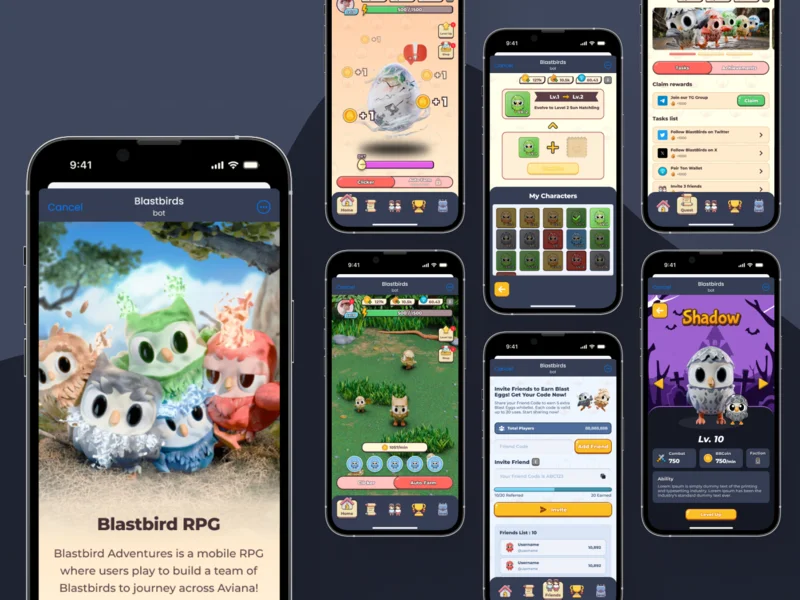
Blastbirds is a 3D Bird NFT collection on the Blast L2 Network, designed for Telegram’s mini-app platform. Using Smartlayer and TokenScript technology, the application enables users to interact directly with NFTs in a game-like environment without external DApps.
The MVP includes three collections—Blast Eggs, Blast Hatchlings, and Blastbird OG NFTs. Users can earn, reveal, and evolve NFTs, aligning with one of five factions: Shadow, Sun, Lava, Ocean, or Nature. This project combines social engagement, gamification, and NFT evolution to introduce users to Web3 through a familiar platform.
b. Development Approach
The development focused on implementing user flows, interactive UI elements, and gamified workflows based on design specifications. Coding efforts prioritized the integration of 3D characters and high-performance rendering on mobile devices.
The implementation built a high-fidelity rendering layout that matches a native mobile game, minimizing rendering bottlenecks for newcomers to Web3.
- Integrated the Telegram Mini App SDK to enable native gameplay loops inside the Telegram client
- Implemented Frontend game mechanics and TokenScript/Smartlayer integration for in-app NFT interactions
- Coded the core Auto Farming mechanics, Hatchling deployment logic, and visual progress tracking
- Developed client-side referral verification and faction alignment features to drive user acquisition
- Optimized 3D asset rendering and resource loading to ensure high performance on mobile devices
- Collaborated with UI/UX designers to translate high-fidelity Figma mockups into responsive code
- Participated in internal usability testing to refine and optimize client-side transactions and workflows
02 — Problems & Challenges
Problems & Challenges
a. Complex Web3 Onboarding & Friction
Traditional NFT platforms require external wallet connections and complex interactions, creating high friction for Web2 users.
To address this, the application was built as a Telegram Mini App. By utilizing Smartlayer and TokenScript, the need for separate DApp redirects was eliminated, allowing users to claim and interact with their assets seamlessly. The development included gamified mechanisms, replacing dense crypto interfaces with a visual, game-like dashboard inspired by popular mini-apps.
b. Interactive Engagement and Retention
Many Web3 projects fail to retain users because their assets are static. Users buy NFTs but have nothing interactive to do with them afterwards.
The frontend introduced gamified interactions like "Auto Farming" and "NFT Evolution" that give users a reason to open the app daily. Users deploy their Hatchlings, watch their progress, and complete social quests to earn rewards, transforming static assets into active gameplay.
03 — Project Goals
Project Goals
a. Frictionless User Acquisition
The primary development goal was to drive user acquisition by making the onboarding process friction-free through Telegram's familiar interface. The project also aimed to keep engagement high by implementing clickable, gamified features and social invite mechanics.
b. Intuitive Asset Management
From a user standpoint, the goal was to provide a seamless transition into Web3, offering intuitive NFT management and clear progress tracking for asset evolution without requiring prior blockchain knowledge.
04 — Development Process
Development Process
a. User Flow and Site Mapping
The development lifecycle began by mapping out the sitemaps. The code was structured to match low-fidelity wireframes before styling the UI according to high-fidelity designs. A dark-mode theme was implemented to highlight the vibrant 3D NFT characters, establishing consistent typography, buttons, and custom progress indicators.
In developing the Auto Farming feature, the layout diverged from traditional crypto farming interfaces. The goal was to build a visually intuitive experience with simplified controls for deploying Hatchlings, dynamic visual feedback for progress, and engaging interactive elements.
b. Auto Farming UI Implementation
In implementing the Auto Farming feature, the development diverged from traditional crypto farming interfaces, focusing on simplicity and user retention.
Instead of complex, data-heavy layouts, the frontend was built to offer a visually intuitive and game-like experience with simplified controls for deploying Hatchlings, dynamic visual feedback for progress, and engaging interactive elements.
05 — Usability Testing
Usability Testing
a. Refining Navigation Flow
Testing was conducted on the Auto Farming and Hatchling deployment features. The development unit monitored how quickly the interface responded, ensuring that the gameplay remained intuitive and clear.
Feedback was gathered to improve transaction state transitions (e.g., Pending, Offered, Accepted).
06 — Prototyping & Handoff
Prototyping & Handoff
a. Interactive Frontend Prototype
A high-fidelity interactive frontend prototype was built to demonstrate the final MVP. The code implements functional tapping animations for cracking eggs, evolution state changes, and referral sharing overlays, ensuring that the design intent was fully realized.
07 — Key Takeaways
Key Takeaways
a. Proactive Learning in New Spaces
Developing for the Telegram Mini App ecosystem was a great opportunity to explore new Web3 standards and gamification.
This experience highlighted how to coordinate visual assets, optimize web layouts for mobile-first views, and implement user-friendly solutions for complex blockchain concepts.